
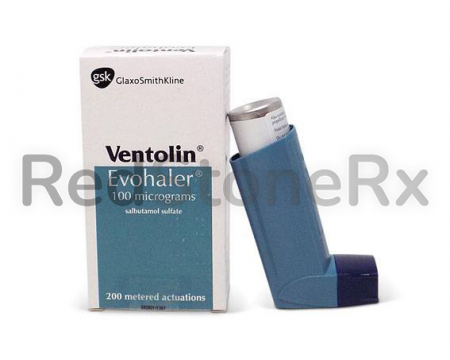
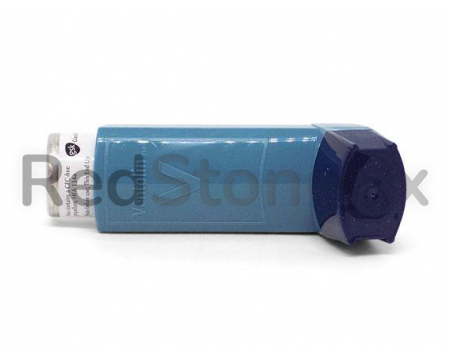
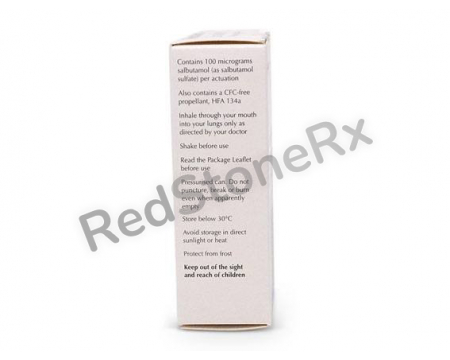


Price for Ventolin Generic Inhaler (Salbutamol 100mcg)
| Product | Dose | Pack | Price (AUD) |
|---|---|---|---|
| Salbutamol Generic Inhaler | 100mcg/actuation | 200 doses | From A$14.99 |
| Salbutamol Generic Inhaler | 100mcg/actuation | 400 doses (2 × 200) | From A$26.99 |
Ventolin Generic Inhaler contains salbutamol sulfate 100 micrograms per actuation — a short-acting beta-2 adrenergic agonist (SABA) delivered via a pressurised metered-dose inhaler (MDI). It is bioequivalent to brand-name Ventolin (GlaxoSmithKline) and delivers the same active ingredient at the same dose using the same CFC-free HFA-134a propellant. This is Australia's most commonly used rescue bronchodilator — salbutamol inhalers are included on the WHO List of Essential Medicines and form the cornerstone of acute asthma management in Australian clinical guidelines.

At a Glance — Four Key Numbers

How Salbutamol Works — Beta-2 Agonist Mechanism
Inhaled salbutamol is a highly selective short-acting beta-2 adrenergic agonist (SABA). When inhaled, salbutamol molecules deposit directly on bronchial smooth muscle cells, binding to beta-2 adrenoreceptors on the cell surface. This activates adenylyl cyclase, increasing intracellular cyclic AMP (cAMP), which activates protein kinase A. The resulting phosphorylation of myosin light-chain kinase and reduction in intracellular calcium ions causes bronchial smooth muscle relaxation — widening the airways and reducing airflow resistance within minutes.
The inhaled route's major pharmacological advantage is its direct delivery to the target tissue at very low doses — a standard 2-puff dose (200mcg) produces equivalent or superior bronchodilation to an oral dose 10–20 times larger, with minimal systemic absorption and far fewer side effects. Beta-2 selectivity reduces cardiac effects, though some tachycardia can occur at higher doses.
Indications and Australian Dosing
| Indication | Dose | Frequency | Notes |
|---|---|---|---|
| Acute asthma symptoms / bronchospasm | 1–2 puffs (100–200mcg) | As needed; may repeat after 4–6 hours | Use with spacer where possible. If no relief after 4 puffs — call 000 |
| Moderate acute asthma (emergency protocol) | 4 puffs via spacer every 4 minutes | Up to 3 cycles — then call 000 | Follow Asthma Action Plan. Call 000 if no improvement after first 4-puff dose |
| Exercise-induced bronchospasm prevention | 1–2 puffs | 15–30 minutes before exercise | Pre-exercise prophylaxis. Use regularly for exercise-associated symptoms |
| COPD bronchospasm relief | 1–2 puffs | As needed, up to 4× daily | COPD requires GP assessment for regular maintenance regimen |
| Children ≥4 years | 1–2 puffs | As needed | Always use spacer with face mask in young children. Technique confirmed by pharmacist or GP |
Correct Inhaler Technique — Step by Step
Poor inhaler technique is one of the most common reasons salbutamol fails to provide adequate relief. Studies show that up to 70–80% of inhaler users have suboptimal technique. Following these steps ensures salbutamol reaches the airways rather than depositing in the mouth or throat.
Asthma Action Plan — Essential for All Australian Asthma Patients
Every Australian with asthma should have a written Asthma Action Plan provided by their GP. An Asthma Action Plan tells you exactly what to do in four situations:
- Everyday management — what medications to take daily, how often to use your reliever
- When asthma gets worse — signs that control is slipping and what to do (increase reliever, start oral prednisolone if prescribed)
- During an asthma attack — the 4×4 rule: 4 puffs every 4 minutes, up to 4 times while waiting for 000
- Emergency — when to call 000 — no improvement after 4 puffs; severe symptoms; lips turning blue
- Sit upright — do not lie down
- Give 4 separate puffs of salbutamol via spacer — one puff at a time, 4 breaths from spacer between each puff
- Wait 4 minutes — if no improvement, repeat 4 puffs
- If still no improvement after second round — call 000 immediately
- Continue 4 puffs every 4 minutes while waiting for emergency services
- Do not drive yourself to hospital during a severe asthma attack
Signs of Inadequate Asthma Control — When to See Your GP
| Sign | What it means | Action required |
|---|---|---|
| Using reliever inhaler more than 2 days per week | Asthma not adequately controlled on current regimen | See GP — preventer inhaler likely needed (2023 guidelines) |
| Waking at night with asthma symptoms | Significant uncontrolled asthma — nocturnal symptoms | See GP urgently — medication review needed |
| Reliever not lasting 4 hours | Severe airway inflammation — acute review needed | Call GP same day or present to emergency |
| Using 3 or more canisters per year | High-risk pattern — associated with severe asthma events | GP review — systematic preventer needed |
| Symptoms not improving after 8 puffs | Severe attack — life-threatening risk | Call 000 immediately |
| Having to miss work or school due to asthma | Inadequate control affecting daily life | GP review — Asthma Action Plan update needed |
Generic Salbutamol Inhaler vs Ventolin Brand — Is There a Difference?
Generic salbutamol inhalers contain the same active ingredient (salbutamol sulfate 100mcg/actuation) at the same dose as branded Ventolin, delivered using the same CFC-free HFA-134a propellant. TGA requires demonstration of bioequivalence before any generic inhaler may be marketed in Australia.
| Parameter | Generic Salbutamol (RedstoneRX) | Ventolin Brand (GSK) |
|---|---|---|
| Active ingredient | Salbutamol sulfate 100mcg/actuation | Salbutamol sulfate 100mcg/actuation |
| Propellant | HFA-134a (CFC-free) | HFA-134a (CFC-free) |
| Doses per canister | 200 | 200 |
| TGA bioequivalence | Confirmed — same efficacy | Reference product |
| TGA Schedule | S3 | S3 |
| Price | Lower — generic pricing | Higher — brand premium |
| Dose counter | Included on canister | Included on canister |
Note: Zempreon (generic salbutamol inhaler, TGA-approved) is another Australian generic available at Chemist Warehouse. All generic salbutamol inhalers must demonstrate bioequivalence to Ventolin before TGA registration. Some individuals notice differences in taste or spray feel between products — this reflects excipient differences, not differences in salbutamol delivery.
From Dr. Sarah Collins, MPharm, AHPRA #PHY0012345: The salbutamol reliever inhaler is the most important medication many Australians carry — but it is being used incorrectly by the majority of patients I see. The two most common errors are inhaling too fast (should be slow and steady) and not holding the breath long enough after inhaling (should be 10 seconds). Both result in most of the drug depositing in the throat rather than reaching the airways. Using a spacer eliminates most of these coordination issues and significantly improves drug delivery to the lungs — I recommend one to virtually all my patients with asthma. The other critical point I emphasise is that needing your reliever more than twice a week is a signal that your asthma is not controlled — not a reason to order more reliever. That pattern should prompt a GP visit for an asthma review and an updated Asthma Action Plan.
Side Effects
Common — generally mild at standard doses
- Mild tremor — hands; much less than oral tablets
- Increased heart rate (tachycardia)
- Throat irritation or hoarseness
- Cough after inhalation
- Headache
- Feeling of nervousness or restlessness
Rinsing mouth with water after each use reduces throat irritation. Side effects are significantly less frequent and less severe than with oral salbutamol tablets at equivalent bronchodilatory doses.
At high doses or with frequent use
- More pronounced tachycardia and palpitations
- Hypokalaemia (low potassium) — clinically important in severe asthma receiving multiple doses; may worsen with concurrent diuretics or corticosteroids
- Hyperglycaemia — especially in diabetics
- Muscle cramps
High-dose salbutamol use (e.g., during severe asthma attack) warrants potassium monitoring in hospital setting.
Stop use — seek emergency care — call 000
- Paradoxical bronchospasm — immediate worsening of wheeze after use. Stop immediately; call 000
- No relief after 4 puffs via spacer — asthma attack not responding; call 000
- Severe allergic reaction — facial swelling, difficulty breathing
- Rapid irregular heartbeat with chest pain
- Lips turning blue (cyanosis) — severe hypoxia; call 000
Drug Interactions
| Drug / class | Interaction | Action |
|---|---|---|
| Beta-blockers (atenolol, metoprolol, propranolol) | Antagonise bronchodilatory effect; non-selective beta-blockers (propranolol) can precipitate severe bronchospasm in asthma | Avoid non-selective beta-blockers in asthma. Discuss cardioselective use with GP |
| Diuretics (frusemide, thiazides) | Additive hypokalaemia | Monitor potassium at high salbutamol doses |
| Digoxin | Hypokalaemia from salbutamol increases digoxin toxicity risk | Monitor potassium and digoxin levels |
| MAO inhibitors, tricyclic antidepressants | Enhanced cardiovascular effects of salbutamol | Use with caution; inform GP |
| Other short-acting bronchodilators | Additive tachycardia; no added bronchodilatory benefit | Do not use two SABA inhalers concurrently |
| Corticosteroids (systemic high dose) | Additive hypokalaemia at high salbutamol doses | Monitor K+ during severe asthma management |
Inhaler Care and Storage
- Store below 30°C — do not leave in a hot car (canister can explode above 50°C)
- Keep away from direct sunlight and moisture
- Do not puncture, burn or incinerate even when empty — the pressurised canister can explode
- Clean weekly: Remove the metal canister from the plastic actuator. Run warm water through the actuator for 30 seconds. Shake dry and allow to air-dry completely before reinserting canister
- Check the dose counter — discard when the counter reads 0 even if the canister still feels like it has contents. The last few doses may not deliver accurate medication
- Discard 13 months after opening foil packaging, or at expiry date — whichever is earlier
- Always carry your inhaler — do not leave home without it
Frequently Asked Questions — Salbutamol Inhaler Australia
Do I need a prescription for the Ventolin inhaler in Australia?
Not always. Salbutamol inhalers are Schedule 3 (Pharmacist Only) — a pharmacist can supply one inhaler without a prescription for patients with known asthma, COPD, or bronchospasm, following a brief pharmacist assessment. This is intended for emergency or urgent supply only. Ongoing supply, more than one inhaler, and PBS-subsidised pricing all require a valid prescription from a registered Australian GP. Telehealth services including HotDoc, InstantScripts and NowPatients can provide online prescriptions.
How is generic salbutamol different from brand Ventolin?
Both contain salbutamol sulfate 100mcg per actuation using a CFC-free HFA-134a propellant and deliver 200 doses per canister. TGA requires demonstration of bioequivalence before any generic is registered in Australia — meaning they are therapeutically equivalent. The price difference reflects brand licensing costs. Some patients notice minor differences in taste or mouthpiece feel; this does not indicate a difference in salbutamol delivery to the lungs.
Should I use a spacer with my salbutamol inhaler?
Yes — Australian asthma guidelines recommend using a spacer device with any MDI puffer. A spacer reduces the need for precise coordination between pressing the inhaler and inhaling, slows the aerosol cloud, and significantly improves salbutamol delivery to the lower airways (reducing throat deposition). For children under 5, a spacer with a face mask is essential. Spacers are available without prescription from pharmacies — ask your pharmacist for advice on suitable spacer devices.
What does it mean if my Ventolin inhaler stops working?
If salbutamol provides no relief or less relief than usual, this indicates worsening asthma or COPD that requires urgent medical review. Do not simply take more puffs and assume everything is under control. If 4 puffs via spacer produce no improvement within 4 minutes — call 000 immediately. If relief is shorter-lived than usual (less than 3 hours), see your GP urgently — this signals deteriorating control.
Can I use salbutamol inhaler during pregnancy?
Inhaled salbutamol is generally considered safe during pregnancy for the management of asthma — poorly controlled asthma poses greater risks to a pregnant woman and her baby than appropriately managed asthma. Discuss your asthma management plan with your GP or obstetrician during pregnancy. The inhaled route minimises systemic exposure compared to oral tablets.
This product page was reviewed by Dr. Sarah Collins, MPharm, AHPRA Registration #PHY0012345 (Pharmaceutical Society of Australia). Information is for general educational purposes only. Salbutamol inhalers are Schedule 3 — one inhaler can be supplied without prescription in an emergency, but ongoing supply requires a prescription. If using your reliever more than 2 days per week, see your GP. In an asthma emergency after 4 puffs with no improvement — call 000 immediately. RedstoneRX complies with all TGA and Poisons Standard requirements for the supply of Schedule 3 medicines in Australia.